The "Your Hotel is Closed" Diversion: Don't Let Your Vacation Be Hijacked
Imagine arriving in a bustling, vibrant city after months of planning. You’ve booked the perfect boutique hotel, read all the glowing reviews, and ...
The "Your Hotel is Closed" Diversion: Don't Let Your Vacation Be Hijacked
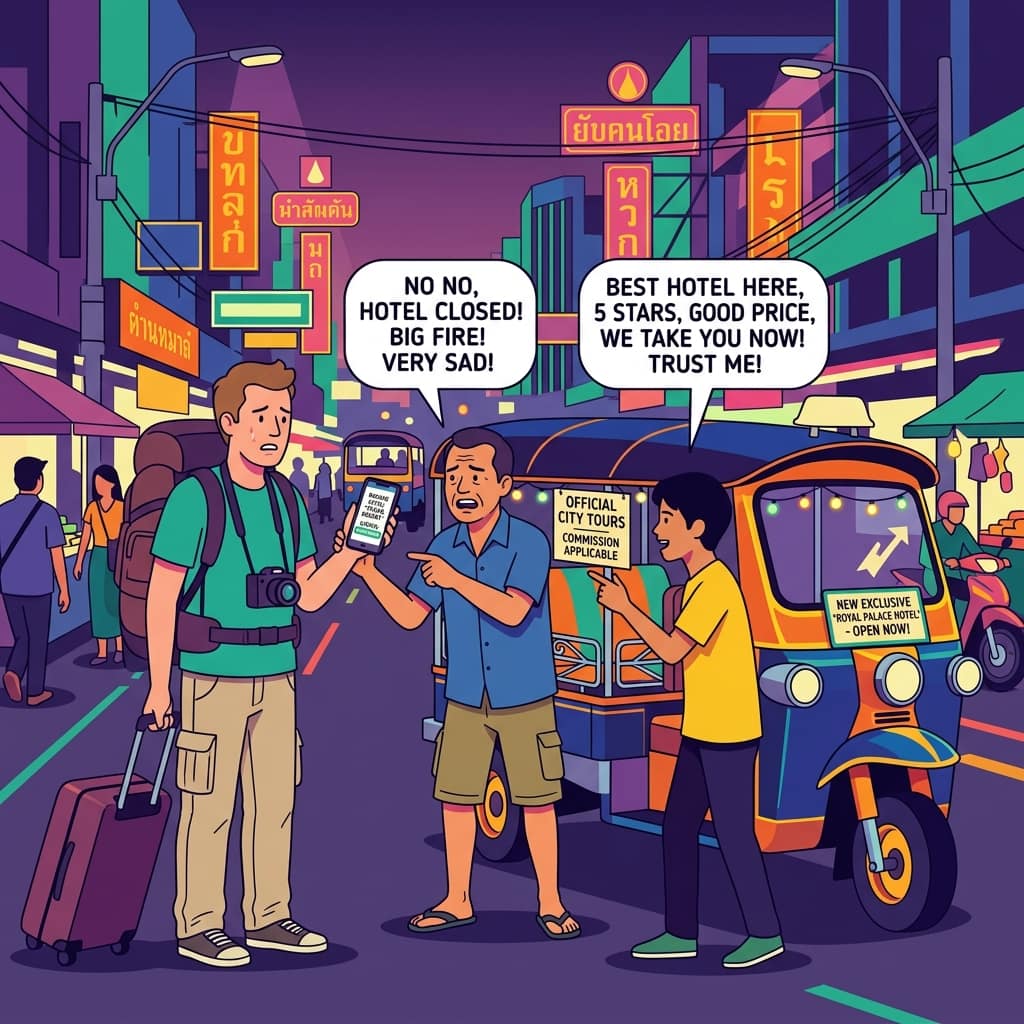
Imagine arriving in a bustling, vibrant city after months of planning. You’ve booked the perfect boutique hotel, read all the glowing reviews, and you can’t wait to drop your bags and explore. You climb into a taxi or tuk-tuk and confidently state the name of your accommodation. The driver shakes their head sadly. "Ah," they say, clicking their tongue. "That hotel burned down last month." Or perhaps, "That street is closed for a religious festival." Or even, "That area is very dangerous now. But don't worry, I know a much better place."
Before you know it, you are being whisked away to a completely different hotel—one that is overpriced, underwhelming, and entirely not what you planned. You’ve just fallen victim to the "Your Hotel is Closed" diversion scam, a highly coordinated deception designed to hijack your travel itinerary for profit.
The Anatomy of the Scam
This diversion tactic is incredibly common in cities where independent taxi drivers or tuk-tuk operators hold significant sway over tourist transportation. It is particularly notorious in parts of India, Thailand, Vietnam, and Egypt, though it happens globally.
The scam operates on a kickback system. The driver isn't redirecting you out of the goodness of their heart; they are doing it because the alternative hotel (or guesthouse) pays them a hefty commission for bringing in guests. This commission is, of course, secretly added to your room rate, meaning you pay significantly more for a subpar experience.
The execution is smooth and well-rehearsed. The driver will sound completely genuine, offering a perfectly plausible reason why your chosen hotel is inaccessible. They might claim the hotel went bankrupt, is undergoing severe renovations, is located in an area currently locked down by police, or is fully booked (even if you have a reservation).
If you express doubt, they might even put on a theatrical performance. They’ll offer to "call" your hotel right from their phone to verify. Unbeknownst to you, they are simply calling a friend or an accomplice who answers the phone pretending to be the hotel receptionist, sadly confirming that yes, your reservation was canceled because the roof caved in.
Fascinating Fact: In some extreme cases, these commission networks are so lucrative that drivers can make up to 50% of your first night’s room rate just for dropping you at the scam hotel's doorstep.
Why It Works (Psychological Tactics)
Scammers rely on the disorientation of travel. When you first arrive in a new country, you are stripped of your usual safety nets.
1. Information Asymmetry: You don't know the local news. If a driver tells you a neighborhood is closed off due to a local holiday or political protest, you have no immediate way to verify if that's true or false, making you likely to trust their "local expertise."
2. The Illusion of Helpfulness: The scam works so well because it's disguised as an act of kindness. The driver isn't demanding money directly; they are acting like a savior rescuing you from a disastrous situation. This makes you drop your guard and feel grateful, rather than suspicious.
3. Panic and Fatigue: After a 12-hour travel day, the idea that your hotel no longer exists is panic-inducing. The driver immediately offers a solution to the crisis they just invented, capitalizing on your desperation to just get into a room and sleep.
How to Spot the Red Flags
The "Your Hotel is Closed" scam has a few distinct hallmarks. Be on high alert if you encounter any of the following:
- Unsolicited Bad News: The moment a driver proactively tells you something is wrong with your accommodation—before you've even gotten close to the neighborhood—be highly skeptical.
- The "Better Alternative" Pitch: If the bad news is immediately followed by a glowing recommendation for a "much better, cheaper, and safer" hotel nearby, you are being set up for a commission scam.
- Refusal to Drive to the Address: If the driver outright refuses to even take you to the address you provided so you can verify the closure yourself, they are lying.
- The Fake Phone Call: If the driver insists on calling your hotel for you using their own phone, assume the person on the other end is an accomplice.
Pro Tip: Always download an offline map (like Google Maps) of your destination before you arrive. If a driver claims a road is closed or a hotel is unreachable, pull up your GPS and insist they follow your route.
What to Do If You're Targeted
If you realize a driver is attempting this diversion, you need to assert control of the situation immediately.
Insist on Your Destination: Firmly tell the driver, "I have a prepaid reservation and my friends are waiting for me there. Take me to the address, even if it is closed." Scammers don't want to waste gas on a lost cause. If they realize you will not stay at their suggested alternative, they will usually drop the act and take you where you want to go.
Call the Hotel Yourself: If you have a sliver of doubt, call your hotel directly using your own phone or a trusted local SIM card. Never let the driver dial the number for you.
Bail Out: If the driver refuses to take you to your original destination or forcefully begins driving toward an unknown location, tell them to stop the car and get out immediately. Pay them nothing, grab your luggage, and find a different driver or use a ride-share app.
Frequently Asked Questions (FAQs)
Q: What happens if I actually get dropped off at the scam hotel? A: If you realize you've been diverted, do not unpack and do not hand over your passport or credit card. Walk out of the lobby, find a café with Wi-Fi, verify the location of your actual hotel, and arrange your own transportation there.
Q: Why do booking sites not warn people about this? A: This scam happens outside the purview of booking platforms. Your reservation at the real hotel is perfectly fine, but the hotel has no control over rogue taxi drivers intercepting their guests at the airport.
Q: Is this scam only for hotels? A: No, this diversion tactic is incredibly versatile. Drivers will also use it to steer you away from famous restaurants, popular shops, or major tourist attractions, claiming they are "closed for lunch" or "burned down," only to take you to a commission-paying restaurant or a fake gem shop instead.
Q: Should I book airport transfers through my hotel to avoid this? A: Yes! Booking an airport pickup directly through your accommodation is one of the safest ways to arrive. While it might cost slightly more than a street taxi, it completely eliminates the risk of the diversion scam, as the driver is directly accountable to the hotel.
Important: If you do end up at a new hotel because you believed the driver, you will likely lose the deposit or full payment you made on your original booking, as the real hotel will register you as a "no-show."
Get more practical guides like this
Follow the RSS feed or send Sahi.info to your WhatsApp circle so the practical guides keep moving.