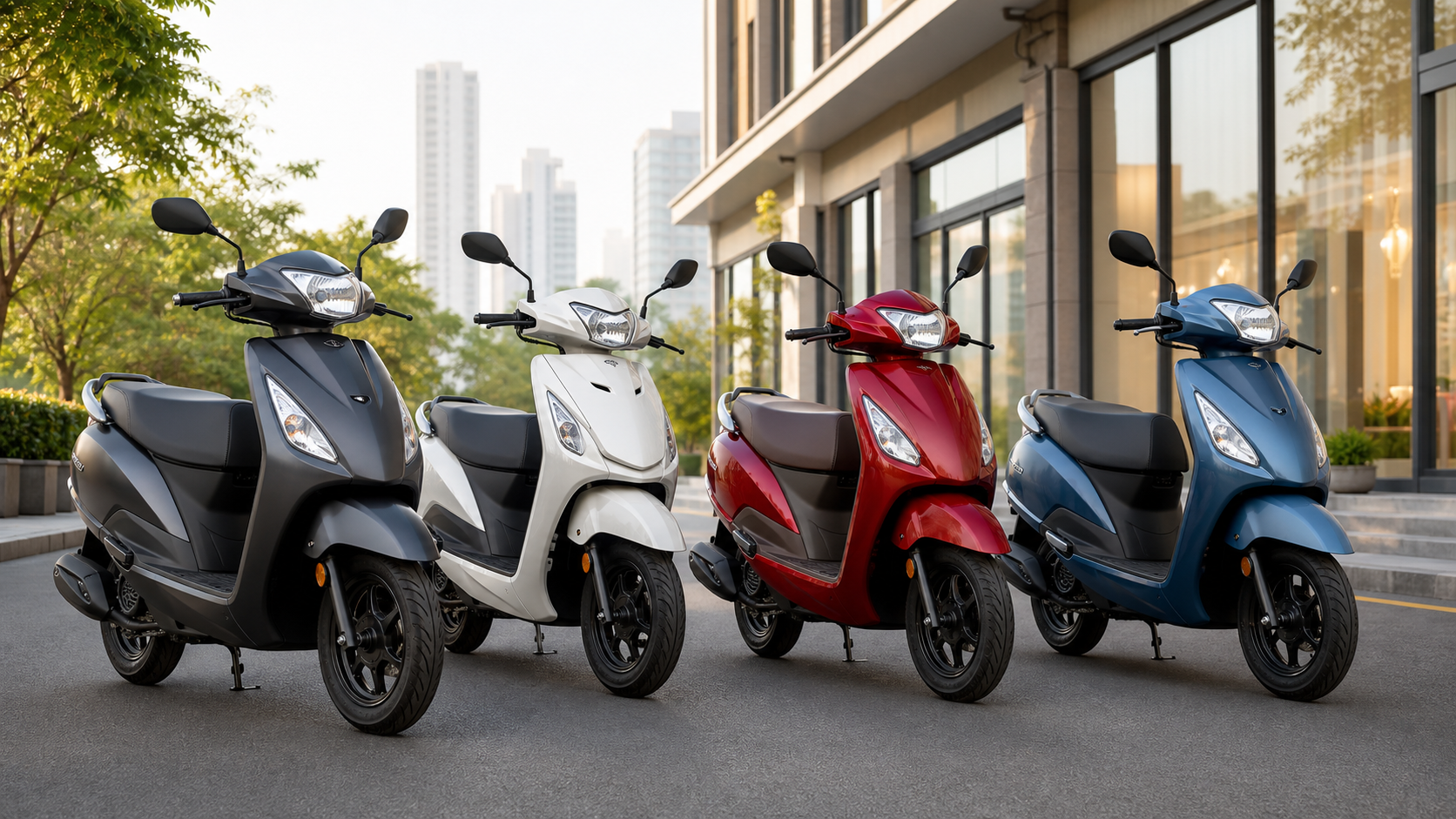
ScootersHonda ActivaTVS NTORQSuzuki Access 125Yamaha FascinoScooters Under 1 LakhIndiaBuying Guide125cc ScootersAutomatic Scooters

Best Scooters Under ₹1 Lakh in India (2026): Eight Scooters Compared — From the Activa to the NTORQ 125

India's scooter segment sells over 6 million units a year, split between practical 110cc commuters and feature-packed 125cc performers. Eight scooters, from the ₹69,900 Hero Pleasure+ to the ₹94,200 Suzuki Access 125, are worth serious consideration. This guide breaks down which is right for your actual riding needs.

S
Sahi.info·June 17, 2026·13 min read

India's scooter market is the second-largest in the world. Over six million scooters are sold in the country each year — a volume built on one insight that manufacturers understood before most buyers did: an automatic scooter removes the single biggest barrier to urban two-wheeler ownership. No clutch, no gear changes, no stalling in traffic.

In 2026, the under-₹1 lakh scooter segment spans two genuinely distinct categories: 110cc commuters tuned for mileage and practicality, and 125cc machines that trade some fuel economy for more power, better features, and a noticeably more premium ownership experience. The correct choice between them depends entirely on how and where you ride.

This guide covers eight scooters — from the ₹69,900 Hero Pleasure+ to the ₹94,200 Suzuki Access 125. For each: what it costs, what it does best, its real weaknesses, and who should buy it.

110cc vs 125cc: The Decision That Matters Most

The segment divides cleanly at the engine displacement line. Understanding the trade-offs before choosing a specific model saves you from buying the wrong category entirely.

A 110cc scooter produces 7.5–8.0 bhp, returns 55–66 km/l in real-world city riding, and is priced between ₹70,000 and ₹82,000 ex-showroom. It is built for distances under 40 km daily, traffic-heavy urban commuting, and buyers for whom running costs and simplicity are the primary criteria.

A 125cc scooter produces 8.2–10.5 bhp, returns 52–65 km/l, and is priced between ₹84,000 and ₹99,000. The power difference feels immediately noticeable on a flyover or highway merge — a 125cc scooter cruises at 70 km/h with noticeable reserve, while a 110cc scooter is near its comfortable ceiling. Feature content — Bluetooth connectivity, digital displays, USB charging, better suspension — is systematically higher in the 125cc class.

The ₹15,000–₹25,000 price gap between the two categories narrows over ownership if you ride longer distances, carry a pillion regularly, or use your scooter on arterial roads where 60–70 km/h is the norm. If you use the scooter strictly within a 10 km urban radius at low speeds, the 110cc option is the financially correct choice.

1. Hero Pleasure+ 110 — ₹69,900* | The Budget Entry

The Hero Pleasure+ is the most affordable scooter from a major manufacturer in this guide. At ₹69,900* (ex-showroom, June 2026), it undercuts every direct competitor on price while delivering a practical, reliable urban commuter built on Hero's proven 110cc platform.

The 110.9cc, single-cylinder engine produces 8.05 bhp and returns a claimed mileage of approximately 57 km/l under real-world conditions. The i3S idle-stop-start system — also found on Hero's motorcycle range — cuts the engine at standstill and restarts it when you roll the throttle, reducing fuel consumption at traffic signals. The external fuel filler cap (no need to open the seat to refuel) is a small but meaningfully practical feature that its 110cc competitors do not always include.

The Pleasure+ 110 has an 18-litre under-seat storage capacity — smaller than the TVS Jupiter (22 litres) but adequate for a helmet and a moderate shopping load. The seat height of 768mm makes it accessible for shorter riders, and the kerb weight of 101 kg is among the lightest in this guide.

What it gives up: the suspension is tuned on the firmer side for its price point, the instrument cluster is basic, and there is no Bluetooth connectivity in any variant. It is a scooter that prioritises cost and simplicity over refinement.

Who should buy it: Buyers for whom purchase price is the single most important criterion, first-time scooter riders who want a light and uncomplicated machine, and commuters covering short urban distances (under 25 km daily) where the 110cc's limitations are irrelevant.

2. Honda Dio 110 — ₹73,500* | Urban Style at 110cc Prices

The Honda Dio is the most visually distinctive scooter in the 110cc category. Honda redesigned it in 2021 around an explicit youth-urban brief — the result is a scooter with a split seat design, sporty body graphics, and a telescopic front fork that is uncommon at this price point and makes a real difference to ride quality over potholes.

The 109.51cc, PGM-Fi (fuel-injected) engine produces 7.68 bhp. Real-world mileage runs around 50–54 km/l in city conditions — not the segment's highest figure, but the fuel injection delivers notably smoother throttle response than carburettor-equipped competitors, particularly in cold starts and stop-start traffic. Honda's Silent Start system (ACG starter motor) means no starter motor noise every morning.

The Dio's practical credentials are solid: under-seat USB-A charging is standard, the boot space is adequate at 18 litres, and an LED headlamp is standard across all variants. The 12-inch wheels (versus 10-inch on most 110cc scooters) give it better stability and a more assured feel on broken urban surfaces — a direct consequence of the larger wheel diameter.

What it gives up: at 104 kg, it is heavier than the Pleasure+ and slightly less fuel efficient than the Activa. It also has no external fuel cap (the seat must be opened to refuel). Boot space is the smallest in the 110cc group covered here.

Who should buy it: Urban buyers who prioritise styling and ride refinement over outright mileage, younger riders who want their scooter to look different from the sea of Activas and Jupiters, and buyers who value the telescopic fork's ride quality advantage on rough city roads.

3. Honda Activa 110 — ₹76,200* | India's Best-Seller for a Reason

The Honda Activa has been India's best-selling two-wheeler for most of the last fifteen years. In a country that sells 15 million two-wheelers annually, sustaining that position is not a marketing outcome — it is an engineering and reliability outcome. The Activa has earned its position through consistent ownership experiences across millions of buyers over two decades.

The 109.51cc, PGM-Fi engine produces 7.68 bhp and delivers approximately 56–60 km/l in real-world city conditions. The Silent Start (ACG motor), mobile charging USB port, external fuel cap, LED headlamp, and a comfortable 790mm seat height are all standard. The under-seat boot space of 21 litres accepts a full-face helmet.

Honda's 6,500+ service touchpoints across India mean you are never far from a dealer who has seen this engine thousands of times. That service network is the Activa's most underappreciated advantage — not just for urban buyers but particularly for tier-2 and tier-3 city owners who depend on local service availability.

Resale value is the Activa's other definitive strength. A three-year-old Honda Activa 110 retains value better than any other scooter in this price range across virtually every used-vehicle market in India. That retained value is a real component of total cost of ownership over a 4–5 year cycle.

The H-Smart variant (₹80,000*) adds the i-Sound engine note enhancement and a slightly more feature-rich instrument cluster — a marginal upgrade that most buyers will not notice in daily use.

Who should buy it: Buyers for whom service access, reliability, and resale value are the primary criteria — which describes the majority of first-time scooter buyers in India. The Honda Activa 110 is the market's reference product because it earns that position year after year.

4. TVS Jupiter 110 — ₹79,000* | The Practical Premium

TVS positioned the Jupiter as the scooter for buyers who want more from the 110cc category — more storage, more comfort, more thoughtful ergonomics — without crossing into 125cc territory on price. The positioning is well-executed.

The 109.7cc, single-cylinder engine produces 7.5 bhp and returns approximately 52–56 km/l in city conditions — the lowest mileage figure in the 110cc group here, which is partly a consequence of the Jupiter's heavier 108 kg kerb weight. The engine is smooth and refined, with a character that feels more settled than either the Activa or the Dio at city speeds.

Storage is the Jupiter's headline advantage: 22 litres of under-seat boot space (the largest in the 110cc segment), an external fuel cap standard across all variants, and a dedicated helmet hook below the apron. The dual-function ignition key includes a shutter mechanism for the external charging port — a small detail that speaks to the engineering thoughtfulness throughout the product.

The Classic variant (₹84,000*) adds SmartXonnect Bluetooth with call alerts, navigation, and ride data. The seat height of 775mm is comfortable for a wide range of rider heights, and the cushioning is notably better than the Pleasure+ over long commutes.

Who should buy it: Buyers who carry a pillion regularly (the wider seat and more powerful engine make this more comfortable), commuters who transport items frequently (the 22-litre boot is genuinely useful), and riders who want the 110cc category's running costs with a noticeably more premium feel.

5. Yamaha Fascino 125 Fi — ₹84,500* | Style Meets Fuel Efficiency

The Yamaha Fascino 125 is the most elegantly designed scooter in this guide. Yamaha's Blue Core engine technology, which underpins the Fascino 125, prioritises fuel efficiency and smooth delivery simultaneously — a combination that most 125cc competitors compromise on. The result is a 124cc, single-cylinder engine producing 8.2 bhp that claims 66.4 km/l (ARAI) — the best mileage figure of any 125cc scooter in this comparison.

Real-world mileage in city conditions runs 52–58 km/l — meaningfully better than the NTORQ or Access 125. The Side Stand Engine Cut Off (prevents the engine starting with the stand deployed) and an engine auto-cut at zero fuel level are standard safety features not seen in all competitors at this price.

The Fascino 125 connected variant (₹90,000*) adds Yamaha's Y-Connect Bluetooth app integration with call alerts, trip data, lean angle sensor (in the Race Blue edition), and fuel consumption display. The instrument cluster is clean and well-designed — not as large as the NTORQ's display but more elegantly integrated.

Yamaha's build quality is consistently the most refined in the Japanese-brand segment under ₹1 lakh. Paint depth, switchgear feel, and the quality of chrome trim are all a level above domestic brands at equivalent prices. The scooter weighs 99 kg — the lightest 125cc in this guide — making it easy to manoeuvre in tight spaces and simpler to park.

Who should buy it: Buyers who want a 125cc scooter's power without sacrificing mileage, urban professionals for whom the scooter's aesthetics matter as much as its function, and buyers who want the most fuel-efficient 125cc under ₹1 lakh.

6. Honda Activa 125 — ₹87,800* | The Premium Honda

The Honda Activa 125 is what the Activa 110 becomes when Honda applies its full engineering attention and a higher price ceiling. The 124cc, PGM-Fi engine produces 8.29 bhp, real-world mileage runs approximately 54–58 km/l, and the refinement of the ownership experience — from the ACG silent starter to the 5.3-inch analogue-digital instrument console to the USB-C charging port standard across all variants — is measurably higher than the 110.

The auto headlamp on (AHO) with LED light, the Pass Switch (for flashing high-beam in traffic), and an under-seat boot of 21 litres are standard. The Smart variant (₹94,000*) adds Bluetooth connectivity, smart key, and an enhanced instrument console with turn-by-turn navigation prompts. The Smart variant's keyless system — start and unlock the seat from your pocket — is the most convenient implementation of this feature in the scooter segment.

Honda's panel quality and paint finish on the Activa 125 are the best among petrol-powered scooters in this guide. The scooter feels solidly built in a way that the NTORQ's sportier but lighter construction does not, and the ride quality from the telescopic front fork and twin-spring rear suspension is well-calibrated for long urban commutes.

Who should buy it: Buyers who want the Honda ownership experience and reliability in a 125cc package, commuters who ride 40–60 km daily and benefit from the extra power and refinement, and buyers for whom resale value is a long-term priority (Honda 125cc scooters retain value exceptionally well).

7. TVS NTORQ 125 Race XP — ₹91,500* | The Performance Scooter

The TVS NTORQ 125 is the only scooter in this guide that takes performance seriously. The Race XP variant's 124.79cc, 3-valve engine produces 10.5 bhp — the highest power output of any scooter under ₹1 lakh in India — and pairs it with a Race mode that extends the rev limit and sharpens throttle response. If you have ever found a scooter boring to ride, the NTORQ addresses that.

The full-colour TFT instrument cluster is the largest and most information-dense display in this segment. It shows gear-shift indication, top speed achieved, lap timer function, lean angle (in Race mode), speed-sensitive Bluetooth audio control, and navigation prompts via SmartXonnect integration with the TVS app. The instrument cluster alone sets the NTORQ apart from every other scooter under ₹1 lakh — it looks like it belongs in a scooter that costs ₹50,000 more.

Street mode delivers everyday usability with a 7.9 bhp soft tune; Race mode opens the full 10.5 bhp with sharper throttle. The differentiated riding modes on a ₹91,500 scooter are genuinely unusual. Combined with 32mm telescopic forks, a monoshock rear, and 12-inch alloy wheels front and rear, the NTORQ handles corners with a precision no other scooter in this guide approaches.

The trade-offs are real: real-world mileage runs 47–52 km/l — the lowest in this guide — and the firm suspension tuning that makes it fun to ride corners means it is less comfortable on very broken roads than the Jupiter or Activa 125. The seat at 790mm is taller than most competitors, which may require reach adjustment for shorter riders.

Who should buy it: Riders who want to actually enjoy the riding experience rather than just complete a commute, young buyers who will use the scooter for weekend rides as well as daily use, and anyone upgrading from a 110cc scooter who wants to feel the difference.

8. Suzuki Access 125 — ₹94,200* | The Refined All-Rounder

The Suzuki Access 125 occupies the premium end of this guide — and its positioning reflects that. Suzuki's SEP (Suzuki Eco Performance) 124cc engine produces 8.7 bhp, returns approximately 60–64 km/l in real-world riding, and does so with a refinement that is unique in this segment. The engine is the quietest among all eight scooters in this guide — noticeably so at idle and at city cruising speeds.

The standard CBS (Combined Braking System) on all variants is the most effective brake setup in this price range: pulling the rear brake lever also applies partial front brake force automatically, significantly reducing stopping distances for riders who habitually use only rear brakes. This safety feature is mandated on some variants in higher segments but is standard on every Access 125.

A fully digital instrument console with eco-drive indicator, 21-litre under-seat boot, external fuel cap, and LED headlamp are all standard. The 790mm seat height and well-padded seat make the Access 125 the most comfortable scooter in this guide for long commutes — the suspension calibration sits between the NTORQ's sportiness and the Jupiter's softness, handling broken roads confidently without the wallowing feel of a purely comfort-tuned setup.

Suzuki's service network in India has grown significantly — over 1,000 authorised dealers and 3,000+ service touchpoints — though it remains smaller than Hero's or Honda's national footprint. In metro cities, this is inconsequential. In tier-3 towns, it warrants a check before purchase.

Who should buy it: Buyers who want the most refined 125cc ownership experience under ₹1 lakh, commuters who cover 50+ km daily and benefit from the mileage-performance balance, and buyers who will keep the scooter for 5–7 years and want quality that ages well.

The Complete Comparison

ScooterPrice*EnginePowerMileage (est.)Best For
Hero Pleasure+ 110₹69,900110.9cc8.05 bhp~57 km/lBudget, short urban hops
Honda Dio 110₹73,500109.5cc7.68 bhp~52 km/lStylish, telescopic fork
Honda Activa 110₹76,200109.5cc7.68 bhp~58 km/lReliability, resale value
TVS Jupiter 110₹79,000109.7cc7.5 bhp~54 km/lStorage, pillion comfort
Yamaha Fascino 125 Fi₹84,500124cc8.2 bhp~55 km/lStyle, best 125cc mileage
Honda Activa 125₹87,800124cc8.29 bhp~56 km/lPremium Honda, long ownership
TVS NTORQ 125 Race XP₹91,500124.8cc10.5 bhp~49 km/lPerformance, features, fun
Suzuki Access 125₹94,200124cc8.7 bhp~62 km/lRefinement, comfort, mileage

*Prices as on June 2026 (ex-showroom, standard/base variant). Verify current prices with your local dealer before purchase.

What to Check Before You Buy

Boot space is more important than most buyers realise at the point of purchase. A full-face helmet requires at minimum 18–20 litres. The TVS Jupiter leads at 22 litres; the Honda Dio is the tightest at 18 litres. If you carry items beyond a helmet regularly, measure what you need to fit before choosing.

Seat height matters for short riders. The Yamaha Fascino 125 at 795mm and the Honda Dio at 775mm represent the extremes in this guide — a 5–6 cm difference that changes how confidently a 5'2" rider can place their feet at red lights. Sit on the scooter before you buy.

Service network in your area is worth a 10-minute check. Open Google Maps, search your preferred brand's authorised service centre, and see how many exist within 15 km of where you live and work. Honda and Hero dominate nationally; Yamaha and Suzuki are strong in metro cities; TVS has wide coverage but is concentrated in South India.

On-road price adds 18–25% to the ex-showroom figure in most states. The Hero Pleasure+ at ₹69,900 ex-showroom lands approximately ₹80,000–₹84,000 on-road. The Suzuki Access 125 at ₹94,200 reaches approximately ₹1,08,000–₹1,12,000 on-road — above the ₹1 lakh mark. Confirm on-road pricing for your specific state registration before using this guide's prices as your budget anchor.

The Final Verdict

Buy the Honda Activa 110 if reliability, service network access, and resale value are your three priorities and you commute under 40 km daily in a city. It is the market's reference product because it earns that position.

Buy the TVS Jupiter 110 if you carry a pillion regularly or transport items frequently. The 22-litre boot and wider seat are practical advantages that justify its price premium over the Activa 110.

Buy the Yamaha Fascino 125 Fi if you want 125cc power with the best mileage in the segment, delivered in the most elegantly designed package under ₹1 lakh. It is the right choice for image-conscious urban professionals who do not want to sacrifice fuel economy.

Buy the Honda Activa 125 if you ride 40–60 km daily, plan to keep the scooter for 5+ years, and want the Honda ownership experience — silent starter, premium build quality, and class-leading resale value — in a 125cc package.

Buy the Suzuki Access 125 if refinement, low engine noise, and the CBS braking system are priorities, and you cover long daily distances where the balance between mileage and performance matters. It is the most complete all-rounder in the 125cc segment under ₹1 lakh.

Buy the TVS NTORQ 125 Race XP if you want to enjoy riding rather than simply complete a commute. The 10.5 bhp, TFT display, dual riding modes, and the firm chassis dynamics make it genuinely fun — a word rarely applied to a scooter under ₹1 lakh. Accept the 49 km/l mileage as the cost of that character.

The scooter segment is the most personal buying decision in this price range. More than motorcycles, scooters are used by people of every age, riding profile, and physical build. The right one is not the one with the best specifications — it is the one that matches how you actually live and ride.

Photos

A scooter being ridden through city traffic, showing typical Indian commuter scooter use

The Honda Activa 110 — India's best-selling two-wheeler for most of the last fifteen years, a verdict built on reliability

Photo by Unsplash on Unsplash
Close-up of a sporty scooter showing its instrument cluster and front end design

The TVS NTORQ 125 Race XP — 10.5 bhp, full-colour TFT display, and dual riding modes on a scooter under ₹1 lakh

Photo by Unsplash on Unsplash
A neatly parked scooter showing its under-seat storage and side profile

Boot space separates the 110cc class — the TVS Jupiter's 22-litre storage leads the segment at this price point

Photo by Unsplash on Unsplash
Person riding a scooter on an open road representing the everyday Indian commuter experience

The Suzuki Access 125 — the quietest, most refined 125cc scooter under ₹1 lakh, built for buyers who ride 50+ km daily

Photo by Unsplash on Unsplash
#Scooters#Honda Activa#TVS NTORQ#Suzuki Access 125#Yamaha Fascino#Scooters Under 1 Lakh#India#Buying Guide#125cc Scooters#Automatic Scooters