BikesMotorcyclesHero SplendorBajaj PulsarTVS RaiderHonda SP 125Bikes Under 1 LakhIndiaBuying GuideCommuter Bikes125cc

Best Bikes Under ₹1 Lakh in India (2026): Nine Motorcycles Compared — From Budget Commuters to Sporty 125s

India's under-₹1 lakh motorcycle segment accounts for 70% of all two-wheeler sales in the country. Nine bikes, from the ₹65,800 Hero HF Deluxe to the ₹98,500 Honda SP 125, are worth serious consideration. This guide tells you which is right for your actual riding needs.

S
Sahi.info·June 17, 2026·14 min read

The under-₹1 lakh motorcycle segment is where 70% of India's two-wheeler buyers make their decision. At this price point, the wrong choice does not just cost you money — it costs you three to five years of daily commuting frustration. The right one runs for a decade with minimal expenditure and gets you to work every morning without drama.

In 2026, this segment has more genuinely good options than at any point in its history. Honda, Hero, Bajaj, and TVS have all sharpened their products: mileage figures are higher, build quality has improved, connected features have arrived even in base variants, and the entry-level 125cc bikes now deliver power that would have seemed ambitious at this price five years ago.

This guide covers nine bikes — from the ₹65,800 commuter that needs nothing but petrol and patience, to the ₹98,500 sporty 125cc that genuinely enjoys a highway run. For each one: what it costs, what it does well, what it gives up, and who should buy it.

Why the Under-₹1 Lakh Segment Matters More Than Any Other

India sells approximately 15–16 million two-wheelers annually. Of those, roughly 65–70% fall under the ₹1 lakh ex-showroom mark. That is not a niche category — it is the primary product category of the world's largest two-wheeler market by volume.

The stakes are correspondingly high. At ₹70,000–₹90,000 on-road, a bike represents four to six months of salary for the median Indian household. The decision affects fuel spending (the difference between 45 km/l and 65 km/l at 2,000 km of monthly riding is over ₹4,000 per year at current petrol prices), service costs, comfort on long commutes, and resale value at the end of the ownership cycle.

Mileage, service network, comfort, and reliability are the four parameters that determine whether a bike under ₹1 lakh is a good investment or a five-year headache. Every recommendation in this guide is evaluated against all four.

1. Hero HF Deluxe — ₹65,800* | The Budget Benchmark

The HF Deluxe is the cheapest new motorcycle you can buy in India from a major manufacturer. At ₹65,800* (ex-showroom, base variant, June 2026), it undercuts its nearest competitor by a meaningful margin and delivers something crucial: total cost-of-ownership predictability.

The 97.2cc, single-cylinder engine produces 8.2 bhp and claims 83.89 km/l under ARAI testing — genuinely exceptional mileage that makes it the most economical motorised vehicle per kilometre of travel available in India new. Real-world figures in mixed riding sit closer to 60–65 km/l, still a number that makes petrol costs nearly negligible for city commutes.

The bike weighs just 112 kg, making it easy to manoeuvre in traffic and simple to park. The i3S idle-stop-start system in higher variants stops the engine at red lights and restarts it when you release the clutch — useful in Indian city traffic where you can spend 10–15 minutes stationary on a typical commute.

What the HF Deluxe is not: a highway bike, a bike for tall riders (seat height 781mm, a low-slung 97cc engine not suited to sustained speeds above 70 km/h), or a bike that will impress anyone on aesthetics. It is a tool for covering urban distance cheaply and reliably. Hero's 6,000+ service centre network means you are rarely far from a technician who knows this engine intimately.

Who should buy it: Daily commuters covering 20–40 km in city conditions, budget-constrained first-time buyers, a second vehicle for household errands, or buyers whose primary filter is the lowest possible monthly running cost.

2. Bajaj CT 110X — ₹66,500* | Budget With Adventure Styling

The CT 110X answers a question nobody else in this price segment was asking: what if a commuter bike looked like an adventure motorcycle? Bajaj takes its proven 115cc engine and puts it in a raised, knobby-tyre-equipped body with a USD-fork-style front end and 17-inch wheels.

It is largely visual — the CT 110X is not an off-road bike and will not survive serious dirt riding — but the aesthetic is distinctive and the practical bones are solid. The 115cc engine returns a claimed 73.84 km/l (ARAI) and has been proven reliable in millions of CT-series bikes over two decades. Ground clearance of 169mm is a genuine advantage over pure-commuter bikes in pothole-heavy conditions.

At ₹66,500*, it is one of the cheapest bikes in India with alloy wheels standard even in base trim. The CT 110X's biggest differentiator is that it looks nothing like the sea of identical commuter bikes that dominate this price point — a genuine advantage for buyers who want character without paying for it significantly.

Who should buy it: Younger buyers who want visual personality without a big premium, semi-urban riders who encounter rough roads regularly, or buyers for whom the CT-series' two-decade reliability record is the deciding factor.

3. Honda Shine 100 — ₹66,500* | Honda's Entry-Level Reliability Play

Honda introduced the Shine 100 as its lowest-cost entry into the mass market — an explicit play for the buyer choosing between the Hero HF Deluxe and the Bajaj CT 110 on price. At ₹66,500*, it positions itself almost identically while bringing Honda's ownership reputation.

The 99cc, single-cylinder engine returns 74.88 km/l (ARAI). The build quality — switchgear feel, paint depth, chrome finish — is noticeably better at this price point than most competition, which reflects Honda's manufacturing standards even on entry-level products. The Eco Indicator on the instrument cluster shows when you are riding in the optimal fuel efficiency band — a small touch that makes a measurable difference over months of ownership.

Honda's service network at 6,500+ touchpoints is the largest in the two-wheeler segment for non-Hero brands. The brand's resale value advantage is real: a three-year-old Honda Shine 100 retains approximately 10–12% more value than an equivalent Hero HF Deluxe in most used-bike markets.

Who should buy it: Buyers who prioritise brand trust and resale value above specifications, buyers in tier-2 and tier-3 cities where Honda's service presence is strong, and first-time motorcycle buyers who want a trustworthy and uncomplicated machine.

4. Bajaj Platina 110 — ₹72,000* | The Comfort Specialist

Bajaj designed the Platina 110 specifically around one brief: make it the most comfortable commuter bike in its price segment. The 110cc, single-cylinder engine returns 89.08 km/l (ARAI) — the highest claimed mileage in the entire 110cc class — and the suspension tuning is notably softer than competitors, prioritising ride comfort over handling precision.

The SNS (Spring-and-Spring) rear suspension uses two springs instead of one to better absorb road irregularities. On broken city roads, the Platina 110 is measurably more comfortable than the Splendor Plus or Honda Shine 100 at the same speed. The 11.5-litre fuel tank gives a theoretical range of over 1,000 km on a full tank at ARAI figures — real-world range of 650–750 km is still the longest in this class.

Who should buy it: Buyers who cover 30–50 km daily on roads with significant potholes and surface irregularities, people who prioritise comfort over spirited performance, and buyers who want the best possible mileage in a 110cc class bike.

5. Hero Splendor Plus — ₹75,500* | India's Bestseller, Twelve Years Running

The Splendor has been India's best-selling motorcycle for over a decade. That is not marketing — it is a consumer verdict delivered by millions of purchase decisions annually. The reason is simple: the Splendor Plus does everything a daily commuter needs and nothing it doesn't.

The 97.2cc, single-cylinder engine returns 79.43 km/l (ARAI). Connected features arrived in the 2024 update: Bluetooth connectivity through the xSense module (in the XTEC variant at ₹82,500*) provides call alerts, turn-by-turn navigation prompts, and ride statistics on a small instrument cluster.

The Splendor Plus rides notably better than the HF Deluxe — the suspension tuning is softer, more comfortable on broken roads, and the seat foam holds up better over long commutes. Hero offers a three-year warranty on engine and transmission, which is the strongest coverage guarantee in this price segment.

Service centres are the Splendor's definitive advantage. Hero has over 6,000 authorised service points across India — more than any other manufacturer — including in towns and semi-urban areas that other brands do not reach. A Splendor owner in a tier-3 city is never more than 10–15 km from authorised service.

Who should buy it: Buyers for whom reliability over 10+ years and nationwide service access are the primary criteria. The right choice for daily commuters in semi-urban and rural areas where the service network matters most.

6. Hero Passion Pro — ₹82,000* | Style and Economy Combined

The Passion Pro occupies an interesting position in Hero's lineup: it is more expensive than the Splendor Plus but more stylish, with a sportier body kit, a digital-analogue instrument cluster, and a slightly more spirited engine tune.

At 79.01 km/l (ARAI), it matches the Splendor's mileage number almost exactly. The visual upgrade is the real differentiator — the Passion Pro has a double-barrel exhaust, alloy wheels standard across all variants, and sharper lines than the functional-first Splendor. For buyers who park the bike outside an office or use it for social occasions as well as commuting, the Passion Pro's aesthetics matter.

The XTEC variant (₹89,000*) adds Bluetooth connectivity, an LED headlamp, side stand indicator, and USB charging — a meaningful feature upgrade that brings it closer to the Honda SP 125 on technology at a significantly lower price.

Who should buy it: Urban buyers who want their commuter bike to look the part, buyers stepping up from a scooter who want motorcycle dynamics but appreciate style, and buyers for whom the Splendor looks too utilitarian.

7. TVS Raider 125 — ₹90,000* | The Best All-Rounder Under ₹1 Lakh

The TVS Raider 125 is the most complete motorcycle under ₹1 lakh in India. It wins on feature content, design, performance, and fuel efficiency simultaneously — a combination no single competitor matches at this price point.

The 124.8cc, single-cylinder engine produces 11.38 bhp and 11.2 Nm of torque. It returns 67 km/l (ARAI) — lower than commuter 110cc bikes but higher than the Pulsar 125 on the same test. The engine has a distinctive character: smooth, willing to rev, and quiet in a way that the busier Pulsar motor is not.

Feature content is the Raider's strongest card. SmartConnect Bluetooth — standard in the connected variant (₹94,000*) — provides call alerts, music control, navigation assistance, ride analysis, and over-the-air firmware updates. The 5-inch semi-digital instrument cluster is the most readable display in this price segment. LED headlamps, LED taillights, USB-C charging, and an external fuel cap are all standard.

The Raider's design is the most considered of any bike in this guide — it is the work of the same TVS design team that shaped the Apache series. It has a coherent visual language and proportions that work across multiple colour options.

Handling dynamics match the sport-commuter brief: firmer than the Platina, more responsive than the Splendor, capable of carving corners in a way that no pure commuter attempts. The 37mm telescopic front fork and monoshock rear are both tuned more sportily than entry-level forks in this class.

Who should buy it: The TVS Raider 125 is the right choice for the widest range of buyers in this guide — commuters who also ride for pleasure, urban professionals who want technology features and design quality, and buyers who do not want to choose between practicality and enjoyment. If you are buying one bike to do everything under ₹1 lakh, this is it.

8. Bajaj Pulsar 125 — ₹92,500* | The Entry-Level Sporty

The Pulsar 125 is the cheapest member of Bajaj's iconic Pulsar family and the entry point for buyers who want sporty styling and some performance ambition without crossing the ₹1 lakh mark. At ₹92,500* (Split Seat variant), it delivers on both counts.

The 124.4cc, single-cylinder engine produces 12 bhp — meaningfully more than any 97–110cc commuter in this guide. The Pulsar 125's claimed mileage of 75.10 km/l (ARAI) is impressive for an engine producing this much power. In city conditions, real-world figures of 55–60 km/l are typical — lower than commuter 110cc bikes but not drastically so.

The Pulsar 125 is the only bike in this price range with a steel-truss frame, a design inherited from the larger Pulsar 150 and 180. This gives it better rigidity and a more confidence-inspiring feel at highway speeds — the Pulsar 125 is genuinely capable of sustained runs at 90–95 km/h, which no 97–110cc commuter in this list approaches comfortably.

Who should buy it: Young riders who prioritise sporty aesthetics and some performance headroom, buyers who use their bike for occasional highway riding (up to 150–200 km stretches), and buyers who want to enjoy riding rather than just use it for transport.

9. Honda SP 125 — ₹98,500* | Premium Reliability at the Top of the Budget

The Honda SP 125 is the most expensive bike in this guide at ₹98,500* — just inside the ₹1 lakh ceiling in its base variant — and it is also the most polished. Honda designed it as a premium commuter, and the execution reflects that intent in materials, finish, and the quality of the riding experience.

The 124cc, single-cylinder PGM-Fi (fuel-injected) engine produces 10.9 bhp and 10.9 Nm. The claimed mileage of 65.4 km/l (ARAI) is lower than the 110cc commuters in this guide but higher than the Pulsar 125 and in the same range as the Raider 125. The PGM-Fi system delivers notably smoother cold starts and better fuel efficiency consistency across temperature conditions compared to carburettor-equipped bikes.

Honda's ACG (Alternating Current Generator) starter motor allows the engine to start silently without the clunk of a traditional starter motor. It is quiet, smooth, and feels premium in a way that stands out every morning. The "Follow Me Home" headlamp function — keeping the light active for 30 seconds after switching off the engine — is a small but genuinely useful feature for dark parking areas.

Build quality is the SP 125's definitive advantage over everything else in this list. Switchgear tolerances, panel gap consistency, and paint finish are measurably better than competitors — the bike feels expensive to touch even though it is not.

Who should buy it: Buyers who want the best build quality and Honda reliability at the top of their ₹1 lakh budget, professionals who value the riding experience as much as the destination, and buyers who plan to keep the bike for 7–10 years and want the best starting platform for that ownership horizon.

The Complete Comparison

BikePrice*EnginePowerMileage (ARAI)Best For
Hero HF Deluxe₹65,80097.2cc8.2 bhp83.89 km/lBudget, max economy
Bajaj CT 110X₹66,500115cc8.4 bhp73.84 km/lBudget, adventure style
Honda Shine 100₹66,50099cc7.68 bhp74.88 km/lHonda trust, resale value
Bajaj Platina 110₹72,000115cc8.6 bhp89.08 km/lBest comfort & mileage
Hero Splendor Plus₹75,50097.2cc8.2 bhp79.43 km/lNationwide service, reliability
Hero Passion Pro₹82,00097.2cc8.2 bhp79.01 km/lStyle + economy, urban
TVS Raider 125₹90,000124.8cc11.38 bhp67 km/lBest all-rounder
Bajaj Pulsar 125₹92,500124.4cc12 bhp75.10 km/lSporty, highway capable
Honda SP 125₹98,500124cc10.9 bhp65.4 km/lPremium build, long ownership

*Prices as on June 2026 (ex-showroom, base/standard variant). Verify current prices with your local dealer before purchase.

What Matters Most: A Buying Framework

Mileage is important but not the only thing. The difference between 65 km/l (SP 125) and 83 km/l (HF Deluxe) at 2,000 km per month works out to approximately ₹3,500–₹4,000 per year at current petrol prices. That is meaningful over five years (₹17,500–₹20,000 total), but it is not the deciding factor if your commute requires a 125cc bike's performance.

Service network access is underweighted by most buyers at purchase and overweighted immediately after the first breakdown. Before buying, check how many authorised service centres your preferred brand has within 10 km of your home and workplace. Hero's 6,000+ centres are a genuine advantage in semi-urban and rural areas. Honda's 6,500+ centres give similar reach with a brand premium.

Resale value varies significantly by brand and model. Honda bikes retain value better than Bajaj in most cities. Hero bikes retain value well in tier-2 and tier-3 markets where the brand commands the strongest recognition. TVS has improved significantly over the past three years as the Raider and Apache lineups have built credibility. In Delhi, Mumbai, and Bengaluru, Honda and TVS lead on resale; in smaller cities, Hero often dominates.

On-road price is what you actually pay. Add registration and road tax (6–9% of ex-showroom price depending on state), insurance (₹3,000–₹5,000), handling charges (₹500–₹1,000), and accessories (at minimum ₹1,000–₹2,000 for a good lock, phone mount, and rain cover). The HF Deluxe at ₹65,800 ex-showroom lands on-road at approximately ₹76,000–₹80,000 in most states. The SP 125 at ₹98,500 lands at approximately ₹1,14,000–₹1,18,000.

The Final Verdict

Buy the Hero HF Deluxe if running costs are your absolute priority and urban city commuting under 40 km daily is all you need. It will return an honest 60+ km/l and run for a decade with minimal expenditure.

Buy the Bajaj Platina 110 if mileage and ride comfort are your two primary criteria. The 89 km/l ARAI figure is no accident — this is the most fuel-efficient mainstream motorcycle in India — and the SNS suspension handles broken roads better than anything in its price class.

Buy the Hero Splendor Plus if you are in a semi-urban or rural area where service network access matters more than features. The 79 km/l mileage, 6,000+ service centres, and three-year warranty make it the most reliable ownership proposition in the guide.

Buy the TVS Raider 125 if you want the best all-around motorcycle under ₹1 lakh. It wins on design, features, dynamics, and the balance between performance and efficiency simultaneously. For urban professionals who ride for pleasure as well as function, nothing in this price range touches it.

Buy the Bajaj Pulsar 125 if sporty aesthetics and the Pulsar legacy matter to you, or if you need a bike capable of comfortable highway riding as well as city work. The 12 bhp output and highway-capable chassis make it the right choice for buyers who want to occasionally open the throttle.

Buy the Honda SP 125 if build quality and long-term value retention are more important than saving ₹8,000–₹10,000 versus the Raider. The silent starter, fuel injection smoothness, and superior panel quality give it an ownership experience that justifies its position at the top of this price range.

The under-₹1 lakh segment rewards careful thought. Most buyers keep their first motorcycle for 4–6 years. The bikes in this guide represent the best of what the segment currently offers. Choose the one that matches your actual use case rather than the one with the most impressive specification sheet.

Photos

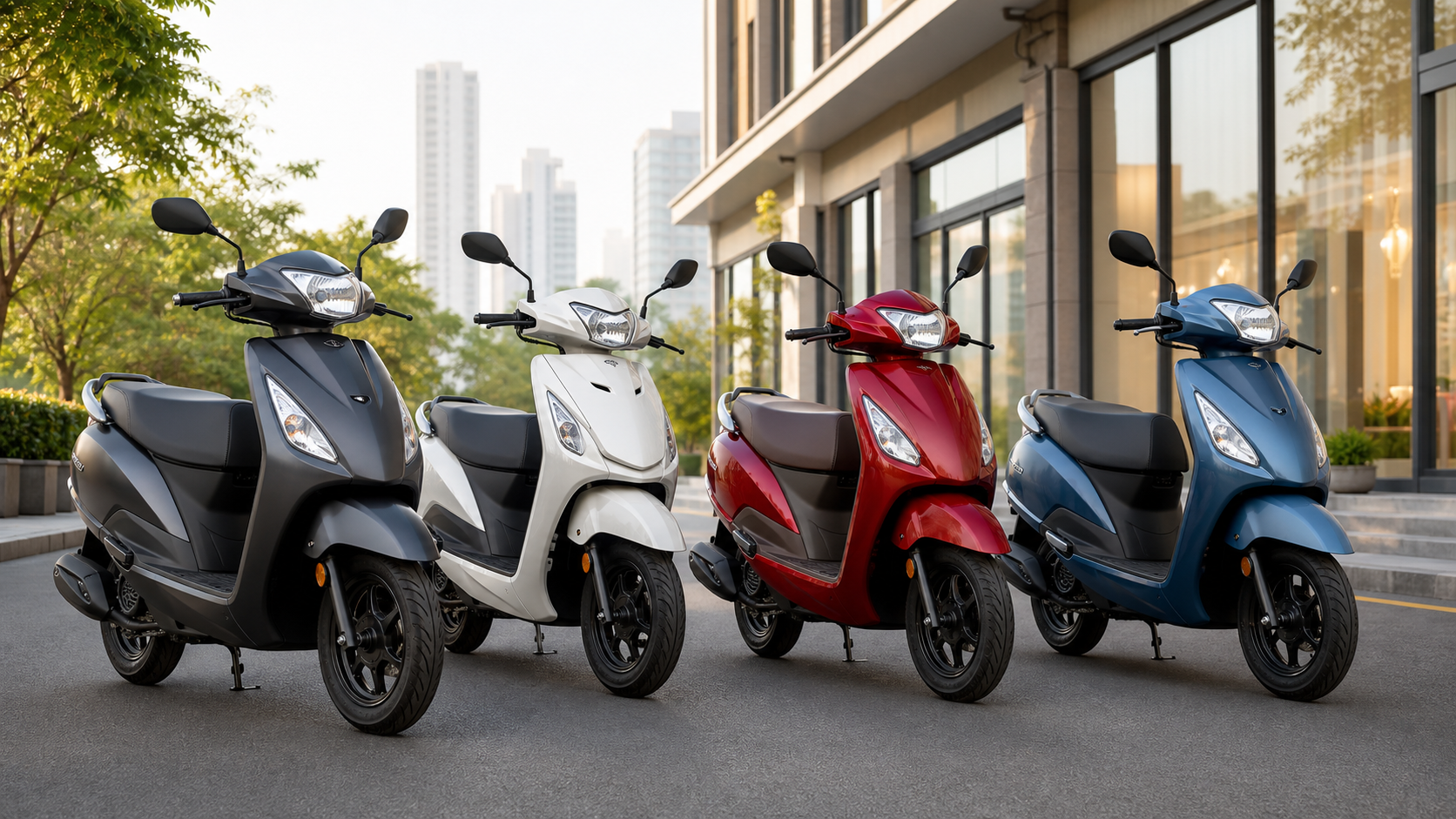
Motorcycles parked on a road, showing the diversity of bikes available in India's commuter segment

From the ₹65,800 Hero HF Deluxe to the ₹98,500 Honda SP 125 — nine bikes worth considering in this price band

Photo by Unsplash on Unsplash
A sporty 125cc motorcycle on a clean road, representing bikes like the TVS Raider 125 and Bajaj Pulsar 125

The TVS Raider 125 — the best all-rounder under ₹1 lakh, combining SmartConnect features, sporty design, and 11.38 bhp

Photo by Unsplash on Unsplash
Close-up of a motorcycle instrument cluster and fuel tank, representing the feature upgrades available in 2026 bikes

Connected features — Bluetooth call alerts, navigation, and ride analytics — are now standard in sub-₹1 lakh 125cc bikes

Photo by Unsplash on Unsplash
A commuter motorcycle navigating city traffic, the primary use case for India's best-selling under-1-lakh bikes

City commuting is the primary use case — and why mileage, service network, and seat comfort matter more than peak power in this segment

Photo by Unsplash on Unsplash
#Bikes#Motorcycles#Hero Splendor#Bajaj Pulsar#TVS Raider#Honda SP 125#Bikes Under 1 Lakh#India#Buying Guide#Commuter Bikes#125cc