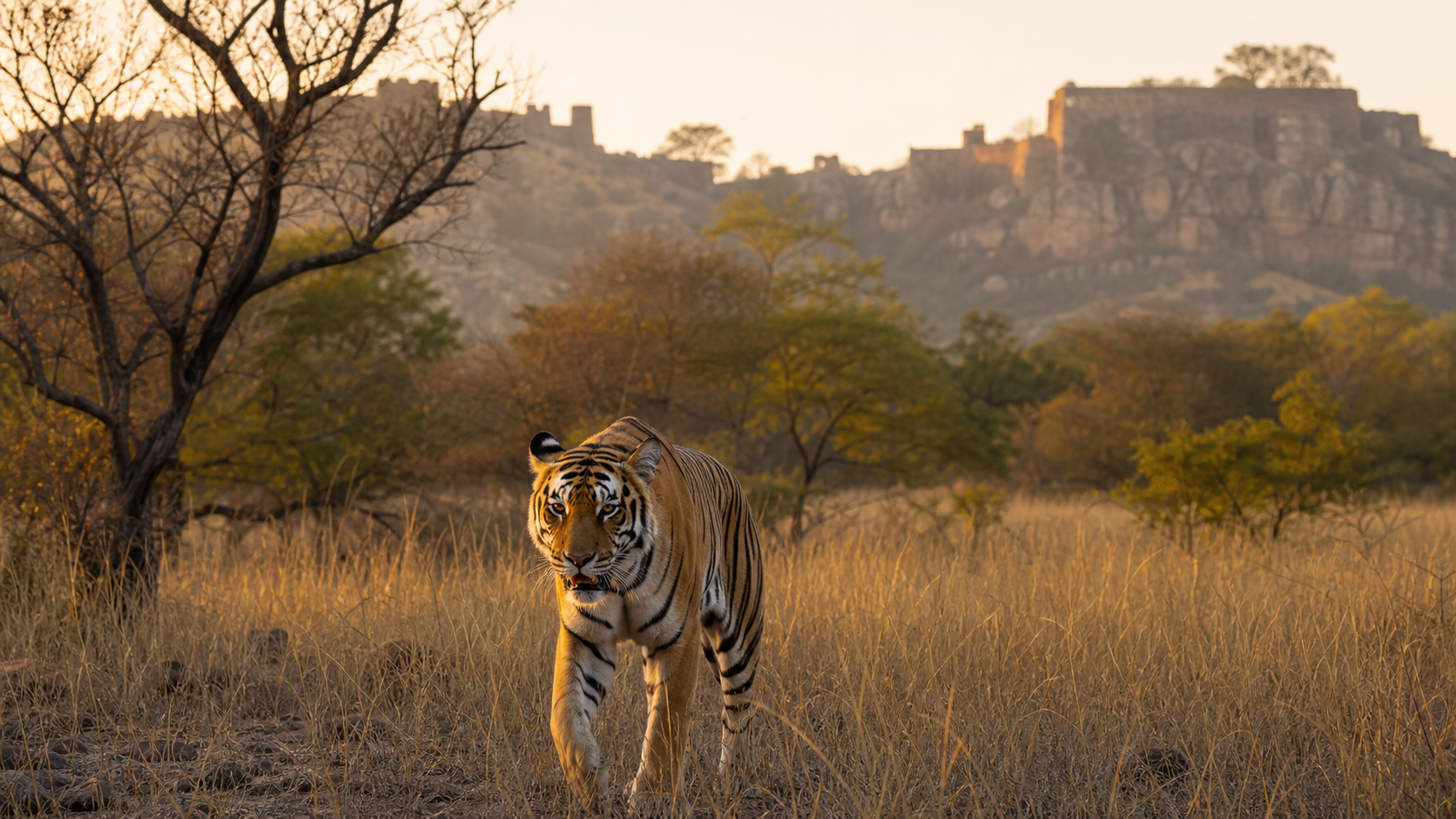
Into the Wild: A Thrilling Wildlife Safari in Ranthambore National Park
Experience the majestic roar of the Bengal tiger and the raw beauty of Rajasthan's wilderness on an unforgettable safari through Ranthambore National Park.
The Kingdom of Ruins and Predators: A Safari in Ranthambore
The sharp, staccato cough of a sambar deer shatters the pre-dawn silence. The open-top Gypsy idles its engine, the air heavy with dust and the unmistakable scent of dry grass and morning dew. We wait, breathless. High in the canopy of a banyan tree, a langur monkey joins the chorus of alarms. Something is moving through the dense dhok foliage of Ranthambore, and my heart hammers against my ribs. This isn't a zoo; we are guests in an ancient, untamed theater where the script is written by the wild.
The Kingdom of Ruins and Predators
Ranthambore National Park, nestled in the rugged terrain where the Aravalli and Vindhya ranges meet in Rajasthan, is a landscape of stark contrasts. As the sun breaches the horizon, painting the sky in bruised purples and burnt oranges, the silhouette of the 10th-century Ranthambore Fort emerges. It stands as a silent sentinel over the forest.
Navigating Zone 3, the juxtaposition of nature and history is striking. Vines choke crumbling stone chhatris (pavilions), and crocodiles bask on the banks of Padam Talao, oblivious to the Mughal and Rajput ghosts that share their watering hole.
Fascinating Fact: Ranthambore was once the private hunting ground of the Maharajas of Jaipur. Today, it stands as one of the most successful examples of Project Tiger, transforming from a hunting reserve into a major conservation success story!
Every safari here is an exercise in suspense. You learn to read the jungle—the alarm calls, the fresh pugmarks in the fine sand, the sudden flight of a peacock. But while the Bengal tiger is the undisputed monarch of these woods, fixation on the stripes can blind you to the forest's deeper magic.
Threads of the Forest
On my second afternoon, the unexpected discovery didn't have fur or claws. Just a few kilometers outside the park gates, in the bustling town of Sawai Madhopur, I stumbled upon Dastkar Ranthambore. This local cooperative was established to provide alternative livelihoods to villagers who were displaced when the park was created. Inside a sunlit courtyard, women from the Gujjar and Meena communities sat chatting animatedly, their hands deftly block-printing fabrics with intricate tiger and tree motifs.
The air smelled of natural dyes and boiling tea. I sat on a woven charpoy with Sunita, a local artisan, who explained how their craft reduces reliance on the forest's resources. Purchasing a beautifully embroidered scarf felt more meaningful than bringing home a plastic souvenir; it was a tangible piece of conservation in action.
A Feast in the Wilderness
The wilderness demands a hearty appetite. After a bone-rattling morning safari, nothing repairs the soul quite like authentic Rajasthani village fare. I found myself at a modest roadside dhaba, guided by my driver, Ram. The setup was simple: charpoys, a clay oven, and the rhythmic sound of dough being slapped into shape.
Pro Tip: Skip the resort buffets for at least one meal. A simple, fire-roasted bajra roti with dal baati churma at a local dhaba offers an incredibly authentic and soul-satisfying taste of rural Rajasthan.
I tore into a thick, fire-roasted bajra (pearl millet) roti, using it to scoop up an earthy bowl of dal baati churma and fiery laal maas—a traditional mutton curry rich with Mathania chilies that left my lips tingling. We washed it down with tall glasses of chilled chaas (buttermilk), spiced with roasted cumin, as Ram shared stories of the legendary tigress Machali, who once famously fought a 14-foot crocodile. The warmth of the food matched the hospitality of the people, turning a simple meal into a masterclass on local lore.
Navigating the Tiger's Territory
A journey to Ranthambore requires a bit of strategy to maximize your experience.
When to Roar
The park is open from October to June. The sweet spot is between November and March when the weather is crisp and pleasant. If you can endure the scorching heat, May and June offer the highest probability of tiger sightings, as the cats frequently visit the remaining waterholes.
Getting There and The Budget
Sawai Madhopur Railway Station is just 11 kilometers from the park and is exceptionally well-connected to Delhi, Mumbai, and Jaipur. The station itself is a work of art, covered in stunning wildlife frescoes.
Ranthambore caters to all wallets. A comfortable homestay costs around ₹2,500 to ₹4,000 per night, while mid-range resorts average ₹6,000 to ₹10,000. For safaris, expect to pay around ₹1,500 to ₹2,000 per seat in a shared Gypsy. Book safaris online through the official Rajasthan forest portal months in advance—they sell out fast.
Important: The jungle demands reverence. Wear muted, earth-toned clothing (khaki, olive, brown) to blend in. Maintain absolute silence during sightings; the animals are sensitive to noise, and flash photography is strictly prohibited.
The Echo in the Trees
As my final safari came to an end, the vehicle rumbled back toward the park exit. The air had cooled, and the evening shadows stretched long and thin across the dirt tracks. I hadn't seen a tiger that afternoon, but as I looked back at the darkening forest canopy, a sambar deer let out another sharp, solitary bark in the distance. I smiled, feeling that same familiar flutter in my chest. Ranthambore isn't merely a place to check an animal off a list. It is a living, breathing mystery that demands your patience, rewards your curiosity, and leaves you forever listening for the next call in the wild.
Frequently Asked Questions (FAQs)
Which safari zone is the best for tiger sightings?
Zones 1 to 5 are generally considered the core areas with higher probabilities of tiger sightings due to water bodies like Padam Talao and Rajbagh. However, tigers roam freely, and sightings can happen in any zone.
Should I book a Gypsy or a Canter?
A Gypsy (a small 6-seater 4x4) is preferred as it is nimbler, can navigate narrower dirt tracks, and offers a less crowded, more intimate viewing experience compared to a Canter (a 20-seater open bus).
Are morning or evening safaris better?
Both have their charms. Morning safaris are cooler and great for bird watching and hearing jungle alarms, while evening safaris offer beautiful lighting and high chances of predator movement as the heat subsides.
FAQ
Which safari zone is the best for tiger sightings?
Zones 1 to 5 are generally considered the core areas with higher probabilities of tiger sightings due to water bodies like Padam Talao and Rajbagh. However, tigers roam freely, and sightings can happen in any zone.
Should I book a Gypsy or a Canter?
A Gypsy (a small 6seater 4x4) is preferred as it is nimbler, can navigate narrower dirt tracks, and offers a less crowded, more intimate viewing experience compared to a Canter (a 20seater open bus).
Are morning or evening safaris better?
Both have their charms. Morning safaris are cooler and great for bird watching and hearing jungle alarms, while evening safaris offer beautiful lighting and high chances of predator movement as the heat subsides.
Get more practical guides like this
Follow the RSS feed or send Sahi.info to your WhatsApp circle so the practical guides keep moving.