Oceanix Busan: The Dawn of Sustainable Floating Cities
As sea levels rise and urban spaces crowd, South Korea's Oceanix Busan emerges as the world's first fully sustainable floating metropolis.
The City That Breathes With the Tides: A Journey to Oceanix Busan
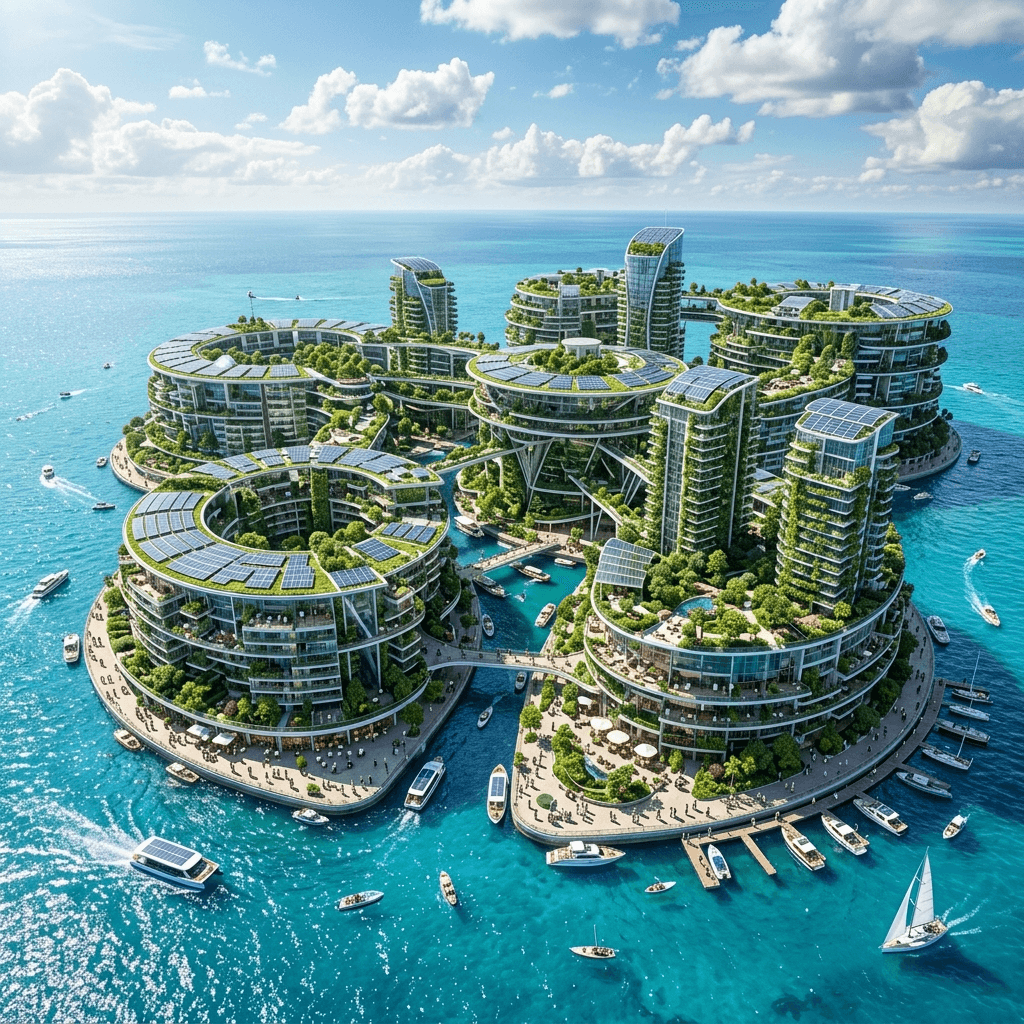
The morning mist over the East Sea was thick enough to taste, a salty veil clinging to the coast of South Korea. I stood at the edge of Busan’s North Port, waiting. As the sun crested the horizon, the fog slowly dissolved, revealing something that looked less like a city and more like a constellation of glowing lilies floating on the water. This was Oceanix Busan, the world’s first sustainable floating city.
There were no massive concrete bridges connecting it to the mainland, only sleek, solar-powered electric ferries gliding silently across the bay. Stepping off the boat and onto the first hexagonal platform, my body braced for the familiar rocking of a dock. Instead, the ground felt immensely solid, yet it carried a subtle, almost imperceptible rhythm—a gentle breathing that reminded me I had left the mainland behind.
Fascinating Fact: Oceanix Busan is fully self-sustaining, generating 100% of its operational energy through solar panels and treating its own water to maintain a closed-loop ecosystem.
Life on the Hexagons
Oceanix isn't a single landmass but a connected web of hexagonal islands, each dedicated to a different aspect of living: lodging, research, and agriculture. The architecture here is low-rise and aerodynamic, designed with swooping bamboo and timber roofs that shrug off heavy coastal winds.
I spent my first afternoon wandering the living platform. The streets are entirely pedestrian. Without the rumble of cars or the blare of traffic, the dominant sounds are the lapping of waves, the hum of wind turbines, and the chatter of locals adjusting to their new amphibious life.
It was here I met Min-su, a marine biologist who had moved to the city to study its artificial reefs. He explained how the very ground beneath us was alive. The platforms are anchored by Biorock—a technology that uses micro-currents to stimulate the growth of limestone, actually repairing the marine ecosystem and attracting local sea life. It was a staggering thought: a city that heals the ocean just by existing.
The Taste of a Zero-Waste Future
That evening, hunger led me to the agricultural platform. Food here isn't just imported; it’s grown in towering hydroponic greenhouses and harvested from the surrounding waters.
I settled into a small, open-air café built entirely of sustainably sourced timber. The menu changes daily based on the harvest. I was served a bowl of steaming noodles in a rich, umami-laden broth made from sea-foraged kelp, topped with crisp vegetables grown just fifty feet away. For dessert, there were strawberries—impossibly sweet and bright, grown without an ounce of soil. Eating here feels intensely intimate, a direct conversation between the water, the sun, and your plate.
Pro Tip: Don't expect to find your usual fast-food chains here. Embrace the zero-waste culinary philosophy by trying dishes crafted entirely from the platform's daily hydroponic yields.
An Unexpected World Beneath
The most remarkable part of Oceanix, however, isn't visible from the surface. On my second day, I descended a spiral staircase into the hull of the research platform. I expected a sterile observation deck. Instead, I found an underwater gallery bathed in filtered blue light.
Large acoustic glass panels offered a clear view into the sea. There, clinging to the Biorock anchors, a nascent reef was already forming. Small schools of silver fish darted through the scaffolding, and a solitary sea turtle glided lazily past the glass. Standing in the quiet cool of the submerged room, watching nature reclaim the foundation of a human city, was profoundly moving. I had expected a triumph of engineering, but I found a sanctuary.
Navigating the Floating City
If you’re planning to experience this marvel for yourself, the transition from land to water requires a bit of preparation.
When to Arrive
Autumn, specifically September through November, is the golden window. The skies are piercingly blue, the humidity breaks, and you avoid the heavy summer rains and typhoon season.
Getting There
Oceanix is accessible via zero-emission electric water taxis from Busan’s main harbor. The ride takes about twenty minutes and costs roughly $10 USD.
Where to Stay and Budget
Accommodation on the living platform consists of eco-pods and boutique floating guesthouses. Expect to pay between $150 and $300 a night. It’s a moderate to high budget destination, largely because a portion of your stay acts as a sustainability tax to maintain the city’s closed-loop energy systems.
Etiquette and Safety
Pack strictly. Single-use plastics are completely banned—and confiscated before you board the ferry. Water is a precious, fully recycled resource here, so short showers are the unspoken rule of good manners.
Important: While the platforms are incredibly stable, if you are highly prone to seasickness, packing a pair of acupressure wristbands is a smart precaution.
The Dance of the Tides
On my final night, I sat on the edge of the living platform, my legs dangling just feet above the dark water. As the evening deepened, the city didn't blaze with harsh neon like the mainland in the distance. Instead, Oceanix dimmed its lights in sync with the stars, a deliberate choice to reduce light pollution for migratory birds and marine life.
I looked out at the glowing, floating lilies, swaying ever so slightly in the East Sea. We have spent centuries building walls to hold back the ocean. Here, in the quiet mist, I realized we are finally learning how to dance with it.
Frequently Asked Questions (FAQs)
What makes Oceanix Busan sustainable?
Oceanix relies on solar power, fully recycles its water, operates on a zero-waste system, and uses Biorock anchors that actively repair local marine ecosystems.
Are tourists allowed to visit the agricultural areas?
Yes, visitors are encouraged to visit the agricultural platform to see the hydroponic greenhouses and dine at local zero-waste restaurants, though strict rules on sustainability apply.
Is the floating city safe from extreme weather?
Absolutely. Oceanix is engineered to withstand Category 5 hurricanes and features aerodynamic architecture that naturally deflects heavy coastal winds.
Photos

India-0037 - Flickr - archer10 (Dennis)
Photo by Dennis G. Jarvis on Unsplash
Hampi, India, Rocky landscape of Hampi, Granite rocks of Matanga Hill
Photo by Vyacheslav Argenberg on UnsplashFAQ
What makes Oceanix Busan sustainable?
Oceanix relies on solar power, fully recycles its water, operates on a zerowaste system, and uses Biorock anchors that actively repair local marine ecosystems.
Are tourists allowed to visit the agricultural areas?
Yes, visitors are encouraged to visit the agricultural platform to see the hydroponic greenhouses and dine at local zerowaste restaurants, though strict rules on sustainability apply.
Is the floating city safe from extreme weather?
Absolutely. Oceanix is engineered to withstand Category 5 hurricanes and features aerodynamic architecture that naturally deflects heavy coastal winds.
Get more practical guides like this
Follow the RSS feed or send Sahi.info to your WhatsApp circle so the practical guides keep moving.