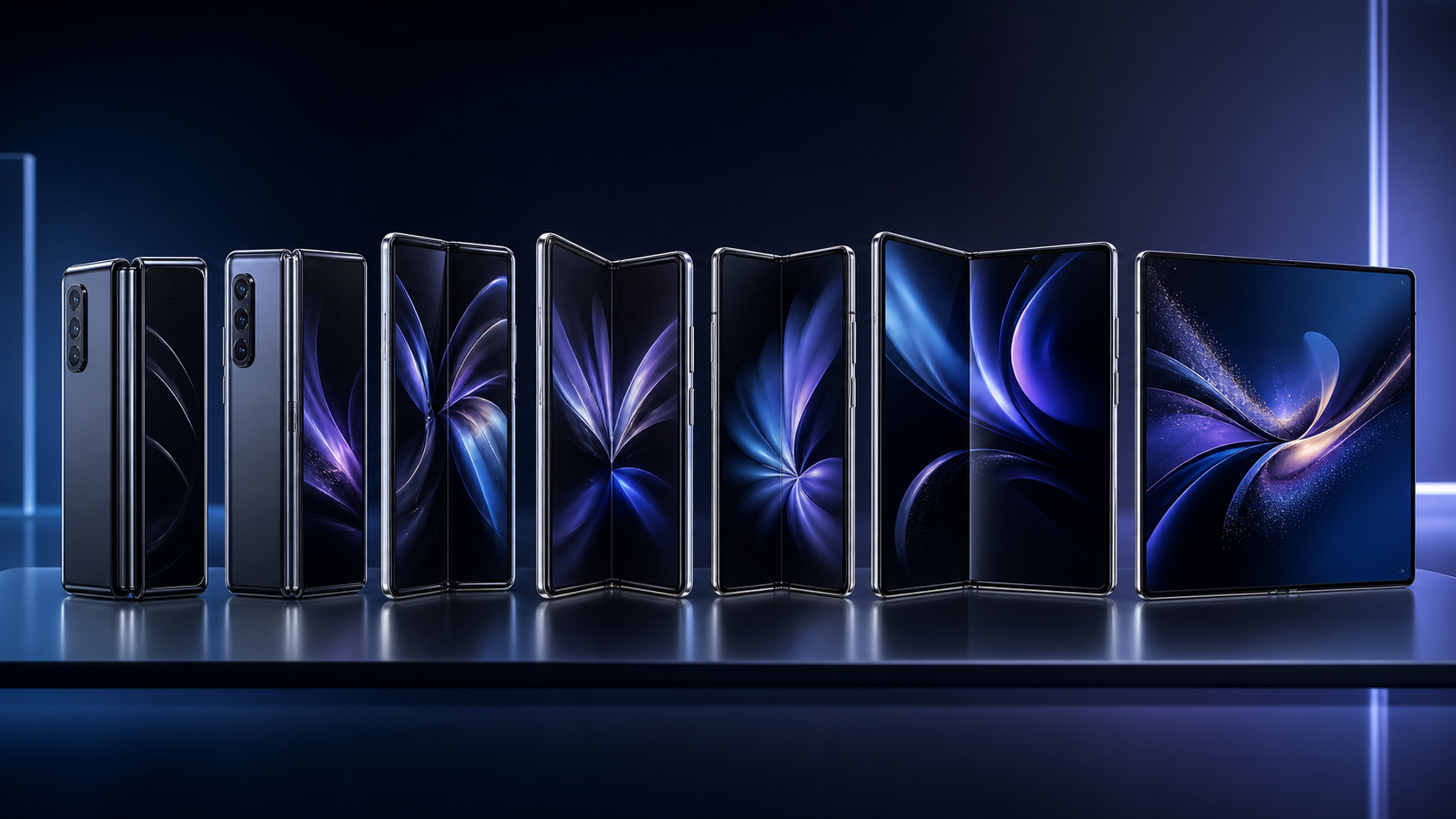
Samsung Galaxy Fold Series: Every Generation Compared — From a $1,980 Experiment to the Thinnest Phone Ever Built
Samsung launched the Galaxy Fold in 2019 at nearly $2,000 and the world called it a gimmick. Six years and seven generations later, the Z Fold 7 unfolds to a larger screen than an iPad Mini and is thinner than any iPhone ever made. Here is the complete story, every generation, every key change.
The Evolution of the Fold: How Samsung Reshaped the Smartphone
Samsung didn't just launch a phone in 2019. It launched a category.
The idea of a smartphone that unfolds into a tablet had lived in concept drawings and patent filings for years before Samsung shipped one. When the original Galaxy Fold arrived at $1,980, the response was equal parts amazement and skepticism. Review units started failing within days. Samsung pulled the launch, reinforced the hinge, added warning labels, and tried again. It was a rough start to what has become one of tech's most successful hardware experiments.
Six years, seven generations, and a complete reinvention of the hinge later, the Galaxy Z Fold 7 unfolds to 8+ inches, weighs just 215 grams, and is 4.2mm thin when open — thinner than any iPhone ever made. This is the full story of how that happened.
The Original Galaxy Fold (2019): The One That Started It All
Samsung unveiled the Galaxy Fold on February 20, 2019, at an Unpacked event that felt genuinely historic. The specs were impressive: a 7.3-inch Infinity Flex Display, a secondary 4.6-inch cover screen, 12 GB of RAM, and six cameras.
The early failures were real. Several review units sent to journalists showed screen damage within 72 hours. Some reviewers had peeled off a protective polymer layer, mistaking it for a standard screen protector. Others reported debris entering the hinge. Samsung delayed the launch, added explicit labels, redesigned the hinge gap, and reinforced the sweep mechanism.
For those who bought it and treated it carefully, the original Fold was genuinely remarkable — the world's first phone you could unfold into a tablet and fold back into your pocket.
Fascinating Fact: Today, nobody calls the original by any other name but "Z Fold", but Samsung launched it simply as the "Galaxy Fold." The "Z" branding didn't start until the second generation in 2020!
Galaxy Z Fold 2 (2020): The "Z" Era Begins
The second generation arrived in September 2020 and addressed the original's most obvious weakness: the cover screen.
Going from 4.6 inches to 6.2 inches transformed the phone's usability. Samsung also introduced Flex Mode, a software feature that split app interfaces in half when the phone was partially open. The redesigned "Hideaway Hinge" with a cam structure allowed the phone to stay open at any angle, like a tiny laptop.
Galaxy Z Fold 3 (2021): Water Resistance and the Stylus
The Z Fold 3 was the landmark generation. Samsung achieved two things nobody had managed in a foldable phone before: official water resistance and stylus support.
IPX8 certification meant the Z Fold 3 could survive 1.5 meters of water for 30 minutes — a standard that had seemed impossible for a moving hinge. S Pen support was the other headline, making the Z Fold 3 a genuinely capable note-taking device.
Pro Tip: If you use the S Pen frequently, invest in a case that specifically houses the stylus, as none of the Z Fold models have a built-in silo like the Galaxy S-Ultra series.
Galaxy Z Fold 4 (2022): Camera Finally Catches Up
The Z Fold 4 closed the camera gap. Samsung gave it the same triple-lens system as the Galaxy S22 Plus: a 50MP main sensor, a 12MP ultrawide, and a 10MP 3× telephoto lens.
The taskbar in Android 12L (built specifically for foldable and large-screen devices) arrived with this generation, giving the inner screen a persistent dock at the bottom for seamless app switching and multitasking.
Galaxy Z Fold 5 (2023): The FlexHinge Changes Everything
Four generations in, the Z Fold still had a fundamental design problem: it couldn't fold completely flat.
Samsung solved it with the FlexHinge — a new mechanism that allowed the display to fold in the shape of a water droplet. For the first time, the Z Fold closed to a flat, gapless profile. The result: noticeably more pocketable and refined. It felt, for the first time, like a mature product rather than an impressive engineering exercise.
Galaxy Z Fold 6 (2024): Galaxy AI and a Square Redesign
Announced in July 2024, the Z Fold 6 arrived with a visual redesign and a major software story. The squared-off corners looked visually closer to the Galaxy S24 Ultra. The Snapdragon 8 Gen 3 for Galaxy powered the full suite of Galaxy AI features: Circle to Search, Live Translate, and Generative Edit. AI was the headline, and it was genuinely useful.
Galaxy Z Fold 7 (2025): Thinner Than Any iPhone
The Z Fold 7 led with two numbers: 8.9mm folded, 4.2mm unfolded. For context, the iPhone 15 Pro is 8.25mm thick. The Apple iPhone 6 was 6.9mm. The Z Fold 7, when open and in use as a tablet, is thinner than any iPhone ever manufactured.
At 215 grams, it is also the lightest Z Fold by 24 grams. Over five years, Samsung shaved the equivalent of a small chocolate bar's weight out of a device that simultaneously grew its inner display from 7.6 inches to 8+ inches.
Important: Despite the massive leaps in processing power, display brightness, and camera tech over 7 generations, the battery capacity has remained exactly 4,400 mAh since the Z Fold 3 in 2021.
The Verdict Across Generations
The Galaxy Fold series is one of the most honest product evolution stories in modern consumer electronics. The first generation was a proof of concept. The second made it usable. The third made it durable. The fourth made it photographically capable. The fifth made it pocketable. The sixth made it intelligent. The seventh made it thinner than the competition's premium slab phones.
It is no longer a compelling curiosity for early adopters. It is the most capable and versatile smartphone Samsung has ever made.
Frequently Asked Questions (FAQs)
Q: Are foldable screens durable enough for daily use? A: Yes. Since the Z Fold 3, Samsung has used Ultra Thin Glass (UTG) combined with specialized protective layers. While they still require more care than a standard glass slab, they are rated for hundreds of thousands of folds.
Q: Has the crease disappeared completely? A: No. While the FlexHinge introduced in the Z Fold 5 significantly reduced the visual and tactile impact of the crease, it is still noticeable under certain lighting conditions.
Q: Can I use any S Pen on the Z Fold? A: No! You must use the "S Pen Fold Edition" or the "S Pen Pro." Standard S Pens have hard tips that can irreparably damage the flexible display.
INTERACTIVE COMPARISON
Samsung Galaxy Fold — all 7 generations compared
Select a generation to explore its specs, evolution, and what changed.
Price
$1,999
Weight
215g
Folded thickness
8.9mm
Cover screen
6.5"
FULL SPECIFICATIONS — GALAXY Z FOLD 7 (2025)
Get more practical guides like this
Follow the RSS feed or send Sahi.info to your WhatsApp circle so the practical guides keep moving.


